 Was there ever a more hubristic statement than this? "My government will be whiter than white" - Tony Blair in 1997. It provokes a hollow laugh now. Can there ever have been a sleazier government in British political history? The record of this government makes any misdemeanours which occurred during the Major years look rank amateur in comparison. No wonder people think all all politicians are either having it away or on the make. Just in case you're in any doubt about the amount of sleaze there's been since 1997, here's a quick reminder. I've identified 56 (yes, 56!) different Labour sleaze scandals since 1997. I'm sure I've missed out a few though, so do post a comment and I'll add anymore to the list. Any journalists should feel free to reprint the list in their newspaper tomorrow... (hat-tip for graphic to quarsan)
UPDATE: We're up to 70 now...
UPDATE 1pm Monday: Pushing 90 now...
April 2006 Cameron MacIntosh says he was offered Peerage for loan
April 2006 Peter Law’s 'peerage'
April 2006 Charles Clarke & the failed deportations
April 2006 John Prescott's Affair(s)
April 2006 Cherie Blair’s hairdressing bill
April 2006 - Jack McConnell under pressure over breaking the ministerial code of conduct by giving public backing to a luxury golf resort planned by Donald Trump which could prejudice the planning process for the development
April 2006 - Revealed that Jack McConnell met with furniture tycoon Robert Morris over compensation to relocate his factory on the route of the M74 extension. The £35million was more than double the original compensation offer
March 2006 - Defeated Labour MP Calum MacDonald gets publicly paid job as Forestry Commissioner
March 2006 Tessa Jowell & husband
March 2006 Peerages for Cash
March 2006 Prescott pays no Council tax
March 2006 Margaret Beckett’s Royal Flights
February 2006 Ken Livingstone loses Standards Board appeal over anti-Jewish remarks
October 2005 Blunkett resigns over links to DNA firm
October 2005 Cherie Gets £100,000 for “charity” speaking tour
October 2005 Stephen Byers apologies for lieing over Railtrack
September 2005 Michael Watson MSP jaimed for arson
August 2005 - Revealed that disgraced former Scottish Executive special adviser, Phil Chalmers, is heading up a bid by French IT firm Atos Origin to secure some of the ID card contracts
July 2005 - Defeated Labour MP David Stewart gets job with the publicly funded SCVO only two months after losing his seat
June 2005 Cherie Opens Shopping centre for Malaysian millionaire
June 2005 Labour MSP Ken MacIntosh resigns over non declaration of financial interests
June 2005 Cherie Blair cashes in on Tony’s Washington trip
May 2005 Birmingham Labour Party accused over post voting irregularities
April 2005 - Brian Wilson MP's final section on Register of Members' Interests shows directorships and advisory roles to renewable energy firms. As Energy Minister he promoted renewable energy
April 2005 - Revealed that Jack McConnell met with Labour donor Willie Haughey to discuss compensation on a land deal where the M74 would pass through Haughey's property. Initial compensation of £7.4 million rose to £16.5 million
March 2005 Labour charges £200 for candidate contact details
February 2005 Cherie Blair embarks on lucrative Australian speaking tour
January 2005 Candy Atherton’s researcher asked to dig for gay Tory dirt
January 2005 - Jack McConnell fails to register a holiday at the Spanish villa of BBC broadcaster Kirsty Wark
January 2005 - Sarah Davidson, once an adviser to former Scottish secretary Helen Liddell, lands a £75,000-a-year job enforcing McConnell’s smoking ban. The new job was never advertised. She was the civil servant who presided over a £200m rise in the cost of Holyrood before taking a six-month sabbatical to travel round the world
December 2004 Oona King offered £10000 to bed Labour Euro MP
October 2004 - Revealed that 70% of Scottish quango appointees have links to the Labour party
August 2004 August 2004 - Former Edinburgh Labour Provost Eric Milligan appointed Scotland’s “welcome czar” to the tourism industry. Although not paid a salary he receives expenses to travel the world
June 2004 - Willie Haughey, who has donated hundreds of thousands of pounds to the Labour party, appointed to the post of chairman of Scottish Enterprise Glasgow.
May 2004 Lord Drayson’s company wins non competitive tender contract after £50,000 donation to Labour
May 2004 - Failed Labour candidate Hugh Raven, a former parliamentary assistant to Peter Peacock, the education minister, awarded a £23,415 contract as a board member of Scottish Natural Heritage
April 2004 Beverley Hughes resigns over Immigration scandal
February 2004 Labour criticised by Electoral Commission for late tendering of accounts
January 2004 - Revealed that Schlumberger hired disgraced special adviser Philip Chalmers to run the Scottish Tourist Board’s Visit Scotland website. The website is part of a Scottish Executive PFI contract
November 2003 Margaret Hodge forced to resign over libelling Demetrious Panton
September 2003 - Harry McGuigan, a leading Lanarkshire Labour councillor appointed as a member of the Scottish Children’s Reporter Administration board
August 2003 David Kelly commits suicide
August 2003 Chris Bryant pictured in briefs on Gaydar website
August 2003 - Defeated Labour MSP Iain Gray appointed as Alistair Darling's special adviser at a salary of £60,000
August 2003 - Failed Labour candidate Pat Kelly appointed to board of Scottish Water.
March 2003 Clive Betts MP employed rent boy in House of Commons office
December 2002 Cherie Blair apologises over links to conman Peter Foster
October 2002 - Lanarkshire Labour party hold a Red Rose Dinner attended by a notorious drug baron called Justin McAlroy
October 2002 - Forty-four constituency Labour parties in Scotland revealed to have failed to register agreements to accept regular donations from trades unions. Failure to do so is a criminal offence
September 2002 Labour MP Alan Meale in trouble over deportation case linked to donation
July 2002 Carphone Warehouse chairman claims Lord Levy tried to nobble a £1 million donation
June 2002 Ken Livingstone accused of manhandling his partner while drunk at a party
June 2002 Black Rod accuses Downing Street of trying to muscle in on Queen Mother's funeral
June 2002 Labour spin doctors accuse Paddington crash victim Pam Warren of being a Tory stooge
May 2002 Stephen Byers resigns from government after various scandals
May 2002 Tessa Jowell criticises Labour for accepting donation from Richard Desmond
March 2002 Lakshmi Mittal
March 2002 Donnygate Doncaster Labour scandal ends in prison for Labour councillors
February 2002 Arthur Andersen & donations to Labour
February 2002 Martin Sixsmith forced to resign by Stephen Byers
February 2002 Jo Moore resigns over ‘burying bad news’ email
January 2002 - Norman Murray, Labour councillor and former convenor of the Convention of Scottish Local Authorities, appointed board member of the Scottish Ambulance Service at £7,305 a year
January 2002 Labour spin doctors trash reputation of Rose Addis
January 2002 Enron accused of buying access to Labour after donation
December 2001 Keith Vaz criticised by Standards Commissioner over business links
December 2001 Nigel Griffiths and £40,000 office expenses
November 2001 Henry McLeish resigns as Scottish First Minister after office expense scandal
November 2001 November 2001 - Jack McConnell admits to affair with Labour party secretary who he tried to keep in situ by appealing to Labour MPs for funds. He says he has had no other affairs
July 2001 Hindujahs receive passports after Labour donation
May 2001 May 2001 - Robin Young, a former non-executive director of Bovis (construction managers of the Scottish Parliament) appointed as permanent secretary at the Department of Trade and Industry
April 2001 - Failed Labour candidate Keith Geddes appointed to board of Scottish Natural Heritage
January 2001 Buyer of Millennium Dome Robert Bourne accused over donation to Labour
January 2001 Peter Mandelson resigns for the second time
November 2000 Cherie Blair & Nannygate
July 2000 David Blunkett fails to declare income from rent on his Wimbledon home
June 2000 Geoffrey Robinson in trouble with Belgian tax authorities
June 2000 Lord Ali in trouble for using House of Lords as business address
April 2000 John Prescott fails to disclose benefit of Union owned flat
January 2000 Geoffrey Robinson faces fraud inquiry over Transtec
January 2000 Gordon Brown faces Inquiry over flat purchased from Maxwell ruins
January 2000 January 2000 - Police arrest Philip Chalmers, who earned £50,000-a-year as head of the Scottish Executive’s strategic communications unit, for being drunk at the wheel of his car in a red light district with a prostitute
October 1999 Ron Davies goes badger watching
October 1999 October 1999 - Failed Labour candidate Joan Aitken appointed as the Prisons Complaints Commissioner
September 1999 Scottish Labour Party lobbying scandal
July 1999 Ken Collins, former Labour MEP, appointed chairman of the Scottish Environment Protection Agency with a salary of £45,000
December 1998 Geoffrey Robinson resigns over loaning money to Mandelson
December 1998 Peter Mandelson resigns over Geoffrey Robinson loan
November 1998 Nick Brown admits paying for gay sex
October 1998 Ron Davies’s Moment of Madness on Clapham Common
July 1998 Downing Street adviser Roger Liddle investigatedover lobbying links
March 1998 Lord Irvine’s £650,000 of wallpaper
March 1998 Scottish Parliament building tendering process & construction
July 1999 Derek Draper & Lobbygate
August 1998 Robin Cook’s affair with Gaynor Regan exposed
November 1997 Bernie Eccleston’s £1 million donation investigated
May 1997 Mohammed Sarwar accused of bribery
Each year Blair's freebie holidays
Was there ever a more hubristic statement than this? "My government will be whiter than white" - Tony Blair in 1997. It provokes a hollow laugh now. Can there ever have been a sleazier government in British political history? The record of this government makes any misdemeanours which occurred during the Major years look rank amateur in comparison. No wonder people think all all politicians are either having it away or on the make. Just in case you're in any doubt about the amount of sleaze there's been since 1997, here's a quick reminder. I've identified 56 (yes, 56!) different Labour sleaze scandals since 1997. I'm sure I've missed out a few though, so do post a comment and I'll add anymore to the list. Any journalists should feel free to reprint the list in their newspaper tomorrow... (hat-tip for graphic to quarsan)
UPDATE: We're up to 70 now...
UPDATE 1pm Monday: Pushing 90 now...
April 2006 Cameron MacIntosh says he was offered Peerage for loan
April 2006 Peter Law’s 'peerage'
April 2006 Charles Clarke & the failed deportations
April 2006 John Prescott's Affair(s)
April 2006 Cherie Blair’s hairdressing bill
April 2006 - Jack McConnell under pressure over breaking the ministerial code of conduct by giving public backing to a luxury golf resort planned by Donald Trump which could prejudice the planning process for the development
April 2006 - Revealed that Jack McConnell met with furniture tycoon Robert Morris over compensation to relocate his factory on the route of the M74 extension. The £35million was more than double the original compensation offer
March 2006 - Defeated Labour MP Calum MacDonald gets publicly paid job as Forestry Commissioner
March 2006 Tessa Jowell & husband
March 2006 Peerages for Cash
March 2006 Prescott pays no Council tax
March 2006 Margaret Beckett’s Royal Flights
February 2006 Ken Livingstone loses Standards Board appeal over anti-Jewish remarks
October 2005 Blunkett resigns over links to DNA firm
October 2005 Cherie Gets £100,000 for “charity” speaking tour
October 2005 Stephen Byers apologies for lieing over Railtrack
September 2005 Michael Watson MSP jaimed for arson
August 2005 - Revealed that disgraced former Scottish Executive special adviser, Phil Chalmers, is heading up a bid by French IT firm Atos Origin to secure some of the ID card contracts
July 2005 - Defeated Labour MP David Stewart gets job with the publicly funded SCVO only two months after losing his seat
June 2005 Cherie Opens Shopping centre for Malaysian millionaire
June 2005 Labour MSP Ken MacIntosh resigns over non declaration of financial interests
June 2005 Cherie Blair cashes in on Tony’s Washington trip
May 2005 Birmingham Labour Party accused over post voting irregularities
April 2005 - Brian Wilson MP's final section on Register of Members' Interests shows directorships and advisory roles to renewable energy firms. As Energy Minister he promoted renewable energy
April 2005 - Revealed that Jack McConnell met with Labour donor Willie Haughey to discuss compensation on a land deal where the M74 would pass through Haughey's property. Initial compensation of £7.4 million rose to £16.5 million
March 2005 Labour charges £200 for candidate contact details
February 2005 Cherie Blair embarks on lucrative Australian speaking tour
January 2005 Candy Atherton’s researcher asked to dig for gay Tory dirt
January 2005 - Jack McConnell fails to register a holiday at the Spanish villa of BBC broadcaster Kirsty Wark
January 2005 - Sarah Davidson, once an adviser to former Scottish secretary Helen Liddell, lands a £75,000-a-year job enforcing McConnell’s smoking ban. The new job was never advertised. She was the civil servant who presided over a £200m rise in the cost of Holyrood before taking a six-month sabbatical to travel round the world
December 2004 Oona King offered £10000 to bed Labour Euro MP
October 2004 - Revealed that 70% of Scottish quango appointees have links to the Labour party
August 2004 August 2004 - Former Edinburgh Labour Provost Eric Milligan appointed Scotland’s “welcome czar” to the tourism industry. Although not paid a salary he receives expenses to travel the world
June 2004 - Willie Haughey, who has donated hundreds of thousands of pounds to the Labour party, appointed to the post of chairman of Scottish Enterprise Glasgow.
May 2004 Lord Drayson’s company wins non competitive tender contract after £50,000 donation to Labour
May 2004 - Failed Labour candidate Hugh Raven, a former parliamentary assistant to Peter Peacock, the education minister, awarded a £23,415 contract as a board member of Scottish Natural Heritage
April 2004 Beverley Hughes resigns over Immigration scandal
February 2004 Labour criticised by Electoral Commission for late tendering of accounts
January 2004 - Revealed that Schlumberger hired disgraced special adviser Philip Chalmers to run the Scottish Tourist Board’s Visit Scotland website. The website is part of a Scottish Executive PFI contract
November 2003 Margaret Hodge forced to resign over libelling Demetrious Panton
September 2003 - Harry McGuigan, a leading Lanarkshire Labour councillor appointed as a member of the Scottish Children’s Reporter Administration board
August 2003 David Kelly commits suicide
August 2003 Chris Bryant pictured in briefs on Gaydar website
August 2003 - Defeated Labour MSP Iain Gray appointed as Alistair Darling's special adviser at a salary of £60,000
August 2003 - Failed Labour candidate Pat Kelly appointed to board of Scottish Water.
March 2003 Clive Betts MP employed rent boy in House of Commons office
December 2002 Cherie Blair apologises over links to conman Peter Foster
October 2002 - Lanarkshire Labour party hold a Red Rose Dinner attended by a notorious drug baron called Justin McAlroy
October 2002 - Forty-four constituency Labour parties in Scotland revealed to have failed to register agreements to accept regular donations from trades unions. Failure to do so is a criminal offence
September 2002 Labour MP Alan Meale in trouble over deportation case linked to donation
July 2002 Carphone Warehouse chairman claims Lord Levy tried to nobble a £1 million donation
June 2002 Ken Livingstone accused of manhandling his partner while drunk at a party
June 2002 Black Rod accuses Downing Street of trying to muscle in on Queen Mother's funeral
June 2002 Labour spin doctors accuse Paddington crash victim Pam Warren of being a Tory stooge
May 2002 Stephen Byers resigns from government after various scandals
May 2002 Tessa Jowell criticises Labour for accepting donation from Richard Desmond
March 2002 Lakshmi Mittal
March 2002 Donnygate Doncaster Labour scandal ends in prison for Labour councillors
February 2002 Arthur Andersen & donations to Labour
February 2002 Martin Sixsmith forced to resign by Stephen Byers
February 2002 Jo Moore resigns over ‘burying bad news’ email
January 2002 - Norman Murray, Labour councillor and former convenor of the Convention of Scottish Local Authorities, appointed board member of the Scottish Ambulance Service at £7,305 a year
January 2002 Labour spin doctors trash reputation of Rose Addis
January 2002 Enron accused of buying access to Labour after donation
December 2001 Keith Vaz criticised by Standards Commissioner over business links
December 2001 Nigel Griffiths and £40,000 office expenses
November 2001 Henry McLeish resigns as Scottish First Minister after office expense scandal
November 2001 November 2001 - Jack McConnell admits to affair with Labour party secretary who he tried to keep in situ by appealing to Labour MPs for funds. He says he has had no other affairs
July 2001 Hindujahs receive passports after Labour donation
May 2001 May 2001 - Robin Young, a former non-executive director of Bovis (construction managers of the Scottish Parliament) appointed as permanent secretary at the Department of Trade and Industry
April 2001 - Failed Labour candidate Keith Geddes appointed to board of Scottish Natural Heritage
January 2001 Buyer of Millennium Dome Robert Bourne accused over donation to Labour
January 2001 Peter Mandelson resigns for the second time
November 2000 Cherie Blair & Nannygate
July 2000 David Blunkett fails to declare income from rent on his Wimbledon home
June 2000 Geoffrey Robinson in trouble with Belgian tax authorities
June 2000 Lord Ali in trouble for using House of Lords as business address
April 2000 John Prescott fails to disclose benefit of Union owned flat
January 2000 Geoffrey Robinson faces fraud inquiry over Transtec
January 2000 Gordon Brown faces Inquiry over flat purchased from Maxwell ruins
January 2000 January 2000 - Police arrest Philip Chalmers, who earned £50,000-a-year as head of the Scottish Executive’s strategic communications unit, for being drunk at the wheel of his car in a red light district with a prostitute
October 1999 Ron Davies goes badger watching
October 1999 October 1999 - Failed Labour candidate Joan Aitken appointed as the Prisons Complaints Commissioner
September 1999 Scottish Labour Party lobbying scandal
July 1999 Ken Collins, former Labour MEP, appointed chairman of the Scottish Environment Protection Agency with a salary of £45,000
December 1998 Geoffrey Robinson resigns over loaning money to Mandelson
December 1998 Peter Mandelson resigns over Geoffrey Robinson loan
November 1998 Nick Brown admits paying for gay sex
October 1998 Ron Davies’s Moment of Madness on Clapham Common
July 1998 Downing Street adviser Roger Liddle investigatedover lobbying links
March 1998 Lord Irvine’s £650,000 of wallpaper
March 1998 Scottish Parliament building tendering process & construction
July 1999 Derek Draper & Lobbygate
August 1998 Robin Cook’s affair with Gaynor Regan exposed
November 1997 Bernie Eccleston’s £1 million donation investigated
May 1997 Mohammed Sarwar accused of bribery
Each year Blair's freebie holidays
Sunday, April 03, 2022
The Top 50 (or so) Labour Sleaze Scandals
Was there ever a more hubristic statement than this? "My government will be whiter than white" - Tony Blair in 1997. It provokes a hollow laugh now. Can there ever have been a sleazier government in British political history? The record of this government makes any misdemeanours which occurred during the Major years look rank amateur in comparison. No wonder people think all all politicians are either having it away or on the make. Just in case you're in any doubt about the amount of sleaze there's been since 1997, here's a quick reminder. I've identified 56 (yes, 56!) different Labour sleaze scandals since 1997. I'm sure I've missed out a few though, so do post a comment and I'll add anymore to the list. Any journalists should feel free to reprint the list in their newspaper tomorrow... (hat-tip for graphic to quarsan)
UPDATE: We're up to 70 now...
UPDATE 1pm Monday: Pushing 90 now...
April 2006 Cameron MacIntosh says he was offered Peerage for loan
April 2006 Peter Law’s 'peerage'
April 2006 Charles Clarke & the failed deportations
April 2006 John Prescott's Affair(s)
April 2006 Cherie Blair’s hairdressing bill
April 2006 - Jack McConnell under pressure over breaking the ministerial code of conduct by giving public backing to a luxury golf resort planned by Donald Trump which could prejudice the planning process for the development
April 2006 - Revealed that Jack McConnell met with furniture tycoon Robert Morris over compensation to relocate his factory on the route of the M74 extension. The £35million was more than double the original compensation offer
March 2006 - Defeated Labour MP Calum MacDonald gets publicly paid job as Forestry Commissioner
March 2006 Tessa Jowell & husband
March 2006 Peerages for Cash
March 2006 Prescott pays no Council tax
March 2006 Margaret Beckett’s Royal Flights
February 2006 Ken Livingstone loses Standards Board appeal over anti-Jewish remarks
October 2005 Blunkett resigns over links to DNA firm
October 2005 Cherie Gets £100,000 for “charity” speaking tour
October 2005 Stephen Byers apologies for lieing over Railtrack
September 2005 Michael Watson MSP jaimed for arson
August 2005 - Revealed that disgraced former Scottish Executive special adviser, Phil Chalmers, is heading up a bid by French IT firm Atos Origin to secure some of the ID card contracts
July 2005 - Defeated Labour MP David Stewart gets job with the publicly funded SCVO only two months after losing his seat
June 2005 Cherie Opens Shopping centre for Malaysian millionaire
June 2005 Labour MSP Ken MacIntosh resigns over non declaration of financial interests
June 2005 Cherie Blair cashes in on Tony’s Washington trip
May 2005 Birmingham Labour Party accused over post voting irregularities
April 2005 - Brian Wilson MP's final section on Register of Members' Interests shows directorships and advisory roles to renewable energy firms. As Energy Minister he promoted renewable energy
April 2005 - Revealed that Jack McConnell met with Labour donor Willie Haughey to discuss compensation on a land deal where the M74 would pass through Haughey's property. Initial compensation of £7.4 million rose to £16.5 million
March 2005 Labour charges £200 for candidate contact details
February 2005 Cherie Blair embarks on lucrative Australian speaking tour
January 2005 Candy Atherton’s researcher asked to dig for gay Tory dirt
January 2005 - Jack McConnell fails to register a holiday at the Spanish villa of BBC broadcaster Kirsty Wark
January 2005 - Sarah Davidson, once an adviser to former Scottish secretary Helen Liddell, lands a £75,000-a-year job enforcing McConnell’s smoking ban. The new job was never advertised. She was the civil servant who presided over a £200m rise in the cost of Holyrood before taking a six-month sabbatical to travel round the world
December 2004 Oona King offered £10000 to bed Labour Euro MP
October 2004 - Revealed that 70% of Scottish quango appointees have links to the Labour party
August 2004 August 2004 - Former Edinburgh Labour Provost Eric Milligan appointed Scotland’s “welcome czar” to the tourism industry. Although not paid a salary he receives expenses to travel the world
June 2004 - Willie Haughey, who has donated hundreds of thousands of pounds to the Labour party, appointed to the post of chairman of Scottish Enterprise Glasgow.
May 2004 Lord Drayson’s company wins non competitive tender contract after £50,000 donation to Labour
May 2004 - Failed Labour candidate Hugh Raven, a former parliamentary assistant to Peter Peacock, the education minister, awarded a £23,415 contract as a board member of Scottish Natural Heritage
April 2004 Beverley Hughes resigns over Immigration scandal
February 2004 Labour criticised by Electoral Commission for late tendering of accounts
January 2004 - Revealed that Schlumberger hired disgraced special adviser Philip Chalmers to run the Scottish Tourist Board’s Visit Scotland website. The website is part of a Scottish Executive PFI contract
November 2003 Margaret Hodge forced to resign over libelling Demetrious Panton
September 2003 - Harry McGuigan, a leading Lanarkshire Labour councillor appointed as a member of the Scottish Children’s Reporter Administration board
August 2003 David Kelly commits suicide
August 2003 Chris Bryant pictured in briefs on Gaydar website
August 2003 - Defeated Labour MSP Iain Gray appointed as Alistair Darling's special adviser at a salary of £60,000
August 2003 - Failed Labour candidate Pat Kelly appointed to board of Scottish Water.
March 2003 Clive Betts MP employed rent boy in House of Commons office
December 2002 Cherie Blair apologises over links to conman Peter Foster
October 2002 - Lanarkshire Labour party hold a Red Rose Dinner attended by a notorious drug baron called Justin McAlroy
October 2002 - Forty-four constituency Labour parties in Scotland revealed to have failed to register agreements to accept regular donations from trades unions. Failure to do so is a criminal offence
September 2002 Labour MP Alan Meale in trouble over deportation case linked to donation
July 2002 Carphone Warehouse chairman claims Lord Levy tried to nobble a £1 million donation
June 2002 Ken Livingstone accused of manhandling his partner while drunk at a party
June 2002 Black Rod accuses Downing Street of trying to muscle in on Queen Mother's funeral
June 2002 Labour spin doctors accuse Paddington crash victim Pam Warren of being a Tory stooge
May 2002 Stephen Byers resigns from government after various scandals
May 2002 Tessa Jowell criticises Labour for accepting donation from Richard Desmond
March 2002 Lakshmi Mittal
March 2002 Donnygate Doncaster Labour scandal ends in prison for Labour councillors
February 2002 Arthur Andersen & donations to Labour
February 2002 Martin Sixsmith forced to resign by Stephen Byers
February 2002 Jo Moore resigns over ‘burying bad news’ email
January 2002 - Norman Murray, Labour councillor and former convenor of the Convention of Scottish Local Authorities, appointed board member of the Scottish Ambulance Service at £7,305 a year
January 2002 Labour spin doctors trash reputation of Rose Addis
January 2002 Enron accused of buying access to Labour after donation
December 2001 Keith Vaz criticised by Standards Commissioner over business links
December 2001 Nigel Griffiths and £40,000 office expenses
November 2001 Henry McLeish resigns as Scottish First Minister after office expense scandal
November 2001 November 2001 - Jack McConnell admits to affair with Labour party secretary who he tried to keep in situ by appealing to Labour MPs for funds. He says he has had no other affairs
July 2001 Hindujahs receive passports after Labour donation
May 2001 May 2001 - Robin Young, a former non-executive director of Bovis (construction managers of the Scottish Parliament) appointed as permanent secretary at the Department of Trade and Industry
April 2001 - Failed Labour candidate Keith Geddes appointed to board of Scottish Natural Heritage
January 2001 Buyer of Millennium Dome Robert Bourne accused over donation to Labour
January 2001 Peter Mandelson resigns for the second time
November 2000 Cherie Blair & Nannygate
July 2000 David Blunkett fails to declare income from rent on his Wimbledon home
June 2000 Geoffrey Robinson in trouble with Belgian tax authorities
June 2000 Lord Ali in trouble for using House of Lords as business address
April 2000 John Prescott fails to disclose benefit of Union owned flat
January 2000 Geoffrey Robinson faces fraud inquiry over Transtec
January 2000 Gordon Brown faces Inquiry over flat purchased from Maxwell ruins
January 2000 January 2000 - Police arrest Philip Chalmers, who earned £50,000-a-year as head of the Scottish Executive’s strategic communications unit, for being drunk at the wheel of his car in a red light district with a prostitute
October 1999 Ron Davies goes badger watching
October 1999 October 1999 - Failed Labour candidate Joan Aitken appointed as the Prisons Complaints Commissioner
September 1999 Scottish Labour Party lobbying scandal
July 1999 Ken Collins, former Labour MEP, appointed chairman of the Scottish Environment Protection Agency with a salary of £45,000
December 1998 Geoffrey Robinson resigns over loaning money to Mandelson
December 1998 Peter Mandelson resigns over Geoffrey Robinson loan
November 1998 Nick Brown admits paying for gay sex
October 1998 Ron Davies’s Moment of Madness on Clapham Common
July 1998 Downing Street adviser Roger Liddle investigatedover lobbying links
March 1998 Lord Irvine’s £650,000 of wallpaper
March 1998 Scottish Parliament building tendering process & construction
July 1999 Derek Draper & Lobbygate
August 1998 Robin Cook’s affair with Gaynor Regan exposed
November 1997 Bernie Eccleston’s £1 million donation investigated
May 1997 Mohammed Sarwar accused of bribery
Each year Blair's freebie holidays


Monday, July 04, 2011
This Blog Is Now Closed
This blog is now closed.
To read Iain Dale's new mega-blog
Dale & Co
go to
http://iaindale.com
from midnight on 8 July
twitter: @daleandcompany
To read Iain Dale's new mega-blog
Dale & Co
go to
http://iaindale.com
from midnight on 8 July
twitter: @daleandcompany
Friday, July 01, 2011
Gio - A Tribute

Gio Simmonsdale
1997-2011
1997-2011
Maybe it's somehow fitting that this will be the last ever blogpost on this blog. It marks the end of two eras - the end of this blog, as in a few days time my new site, Dale & Co launches, and also the end of a life.
Five hours ago my beloved little Jack Russell, Gio, died. Those of you who have ever had the privilege of owning a dog will know what a devastating time this is for me and my family, who loved him with all our hearts. It is scant consolation to know that we gave him the best life a dog could possibly have, as a gaping hole has opened up in our lives, which can never, ever be filled.
Most Jack Russells are characters, and Gio was no exception. He was a cheeky little blighter and had us all wrapped around his little paws.
 Gio was a Battersea dog. Back in early 1998 we went to Battersea, ostensibly to get a fully grown, house trained dog. We emerged with a six week old Jack Russell puppy who was so small that I could hold him in the palm of my hand. People often ask why we called him Gio? I wanted to call him Rio, after Rio Ferdinand, but that was vetoed by he who must obeyed. But I wear an aftershave called Aqua di Gio, and as I was shaving one morning I saw it on the shelf and thought to myself that Gio sounded enough like Rio, and it was just right for him. After that, my aftershave became known as Gio’s piss...
When I grew up we had always had Jack Russells so I knew what wonderful dogs they could be, but I had no idea this little mite would give us so much pleasure and become such an integral part of our lives. He was a dog that everyone loved. And Gio loved them back. Well, almost everyone. He didn’t care much for children, and let them know it in a typical Jack Russell kind of way - he would give them a nip. For some unfathomable reason he also didn’t like people on bicycles. If he saw someone riding a bike he would literally go mental.
During the first few years of Gio’s life, he would come to work with John and me at our Westminster bookshop, Politico’s. We barred him in behind the counter, but on several occasions he escaped and delighted running round the shop at full pelt, causing total havoc. The customers thought it was an absolute hoot.
 In his early years Gio was a very fit and active dog. He loved going to the park and haring after a tennis ball I would throw. He never tired of it and would happily carry on for half an hour given half a chance. Sadly, this activity came to an end when one day he jumped off a sofa and damaged a knee ligament. Although we were still able to take him for walks, he wasn’t allowed to run at all, which meant that over time he became a bit of a porker. This proved to be a real problem as Gio was a terrible food thief. You’d give him his meal and ten minutes later he’d give you a look which said “Daddy, why are you starving me, give me some of your doughnut”. And believe me, he had this look which made you want to give in to his every demand. We didn’t, but felt very guilty for refusing him anything.
My worst memory of Gio's life was when he was run over. And it was my fault. He was on an extendable lead and I was walking ahead of him when I suddenly became aware of an approaching car. It happened in slo-motion. I heard a thud, and then Gio emerged from the side of the car and sat down on the pavement holding his paw up. I gathered him up, ran home bawling my eyes out, thinking he would die. We put him in blankets and rushed to the vet who diagnosed a sprained leg. It could have been so much worse.
Back in 2005 Gio spent a morning with me on the general election campaign trail in Cromer. We bought him a union jack coat. But sadly even Gio’s charms couldn’t rescue me from an inglorious defeat at the hands of Norman Lamb.
Gio was a dog that liked his routine. At 2pm precisely he would sit by the dog chew draw. At 10pm he would demand his nightly rich tea biscuit and slurp of cranberry juice. On his nightly walk he would go so far and no further. And like all Jack Russells, a walk in his view was less about exercise and more about having a good old sniff.
 But over the last year there had been a clear decline in the little scamp’s health. He developed a slight heart problem and seemed to pant too much. We were warned by the vet that he might not be long for this world. But he was a doughty fighter and bounced back again. But just before I went to Australia it became clear that he was struggling. I dreaded going away for three weeks with the thought in the back of my mind that I might not see him again. My partner John and I chatted on Skype video twice a day and I made him show me Gio each time, just so that I could be reassured he was still alive. I know John dreaded having to tell me he had died while I was away.
Whenever I go away the one thing that keeps me going is the thought of the welcome Gio will give me when I get home. And that was my abiding thought as I flew back from Australia the Sunday before last. But instead of being delighted to see me when I walked though the door, and instead of giving my face a good licking, he just looked at me to say “Oh, you're back then.” And then he wandered into the kitchen. I was gutted. And I knew then that something was seriously wrong. He had also clearly lost a lot of weight. He’d come to my sofa for “a love” – and just stare u at me into my eyes, as if to say “Daddy, what’s wrong with me, please put it right”. That look never failed to bring a tear to my eye.
 Anyway, the vet then diagnosed diabetes. We were told he’d need an insulin injection every day. But then a minor miracle happened. An hour after the first injection he was back to his old self. He was eating properly, full of life, tail erect, being cheeky, keen to go on his walk, and everything seemed right with the world. But it wasn’t to last.
I got home from my radio show on Friday night to find that a few minutes before I got there he had had what we thought was a hypoglycaemic attack. He had fitted. We got the vet out to see him, hoping beyond hope that he would be able to fix him. Instead he delivered the devastating news that Gio was unlikely to make it through the night. It appeared he had had a stroke. He wasn’t in pain, but the sadness in his eyes told its own story. As the hours wore on, his breathing got gradually weaker, and at 5.30am he passed away.
Our lives will never be the same. He meant everything to John and me. He and John were devoted to each other. Gio knew that if he felt ill, it would be John that would make him better. He was the constant in Gio's life. John and I are very different. John is stoic and knows what to do if Gio is in pain. I collapse into an emotional jelly. And so it was last night. Gio spent most of his ast few hours staring up at John and I. If he could have spoken, he would have said to John: "Thank you, Daddy, thanks for being there for me. Thanks for giving me a wonderful life".
If you haven’t had a dog in your life you cannot comprehend the gaping void that can never, ever be filled. Someone said the best thing to do it get another dog immediately. I just couldn’t. It would feel like betraying his memory.
As I complete this tribute to the best friend I am ever going to have, it provides little solace to know in my heart that we gave Gio the best life a dog could ever have. Maybe one day we’ll feel ready to try to do the same for another rescue dog. But there will never be another Gio.

Monday, June 13, 2011
Australian Diary: The Second Week
Sitting here basking in 32 degree heat, looking out over a balmy Darwin sunset in northern Australia I am wondering why anyone would ever leave this heavenly place. I’ve been in Australia for nearly two weeks and have loved every minute of it. It’s a truly fabulous country and it’s easy to see why so many Brits come here to live. It’s a very optimistic country and you get a sense of the optimism just by looking into people’s faces as you walk down the street. Strangers smile at you. They chat to you with ease. There are none of the scowls you get if you ever make eye contact with anyone on the streets of London. There’s none of the scepticism so prevalent in our society in the UK. This is a can do country with a positive attitude.
The political part of my trip ended a week ago – I was here to deliver a number of speeches for Microsoft Australia, two of which were in Parliament House in Canberra. So with that part of the trip over with, it was time to do a little relaxing and sightseeing.
 On Monday I took train ride up the coast to Newcastle, and very scenic was too – the train ride, I mean, not Newcastle. I got to Sydney Central station early in the morning and bought my ticket, which was unbelievably cheap. Bearing in mind it was a 320 km round trip it only cost £8. I took comfort in the fact that it was about the only cheap thing I had encountered on my trip so far. I then asked how much a first class ticket would be. “Sir, all our seats are first class.” That put me in my place,
The journey through the Hawkesbury River was stunning. The train never seemed to break more than about 50mph and it took three hours before we arrived in Newcastle. I had been warned that it wasn’t exactly a beautiful town, and so it proved. I wandered round the harbour area and up to Nobby’s Beach (yes, honestly) before waiting to catch a trolley bus tour of the town at 1pm. The trolley bus duly arrived and I turned out to be the only customer. The driver said he couldn’t take me on my own but would drop me at the town’s new maritime museum. Which he did. And it was closed.
Buses in Newcastle are free, and all of them run virtually empty. There’s a lesson there somewhere. I was amused to see that the buses were going to outlying town suburbs called Morpeth and Wallsend! So back to Sydney I went, and enjoyed the scenic railway for a second time.
In the evening I met Alice Wright for dinner in a wonderful Italian restaurant in Surry Hills. Alice was the floor manager at 18 Doughty Street and is now living in Sydney with her Aussie boyfriend. She is a speechwriter for the New South Wales minister for tourism. It was great to see her again and reminisce about all the programmes we made together.
 It was another early start on Tuesday. I was picked up shortly after 7am from my city centre apartment by a tour company who were taking me on a tour of the Blue Mountains. James, the tour guide, immediately told me the bus would be very full. “There are two of you,” he joked. And there were. Me and a Canadian girl called Angela. The advantages of travelling in the Australian winter. We started off by visiting an Aboriginal Cultural Centre and then headed up into the mountains. Stunning scenery and more than a little of the Grand Canyon about parts of it. We even saw some kangaroos. I know it’s pathetic, but that was the highlight. “Whatcha say, Skip? Grandma’s fallen down a mineshaft?” Readers of a younger generation won’t get that, but those of us who were brought up on Skippy the Bush Kangaroo will!
 On Thursday I flew up to Darwin to spend the weekend with Shane Stone, a friend of mine who is a former Chief Minister of the Northern Territory. It’s a four hour flight from Sydney. To give you some geographical perspective, Darwin is further from Sydney than London is from Moscow. It’s the dry season in Darwin at the moment and a very pleasant 30 degrees. We were joined by two of Shane’s colleagues and were immediately driven to Crocosaurus Cove where we saw some very big crocodiles indeed! On Friday morning we headed out to Channel Point, which is a 140 mile drive, mainly on dirt roads. It’s on the coast, opposite the Peron Islands and is a compound of about 20 properties. It’s totally isolated from anywhere. You walk along the beach and you feel as if you are about to star in an episode of LOST. I’ve never been fishing before, but that’s what people do here. All the time. All day. Except that the wind was too strong, thereby preventing us from going out on the water. But we fished in a creek and laid crab traps. I eventually learned how to cast a rod, but didn’t end up catching anything. But I did catch crabs. There’s a joke there somewhere.
We headed back to Darwin this morning. I had to laugh at the start of an article in the local Darwin newspaper today. “Darwin is in the grip of winter. Temperatures descended to a chilly 25 degrees centigrade yesterday...” You have to laugh.
We caught the afternoon flight back to Sydney. I’m now gearing myself up for the final week of my stay here, which will be dominated by broadcasting my LBC show every day from 4am-7am from the Today FM studios.
And I am going to meet some long lost relatives in Sydney, I never knew I had. More of that another time.
The political part of my trip ended a week ago – I was here to deliver a number of speeches for Microsoft Australia, two of which were in Parliament House in Canberra. So with that part of the trip over with, it was time to do a little relaxing and sightseeing.
 On Monday I took train ride up the coast to Newcastle, and very scenic was too – the train ride, I mean, not Newcastle. I got to Sydney Central station early in the morning and bought my ticket, which was unbelievably cheap. Bearing in mind it was a 320 km round trip it only cost £8. I took comfort in the fact that it was about the only cheap thing I had encountered on my trip so far. I then asked how much a first class ticket would be. “Sir, all our seats are first class.” That put me in my place,
The journey through the Hawkesbury River was stunning. The train never seemed to break more than about 50mph and it took three hours before we arrived in Newcastle. I had been warned that it wasn’t exactly a beautiful town, and so it proved. I wandered round the harbour area and up to Nobby’s Beach (yes, honestly) before waiting to catch a trolley bus tour of the town at 1pm. The trolley bus duly arrived and I turned out to be the only customer. The driver said he couldn’t take me on my own but would drop me at the town’s new maritime museum. Which he did. And it was closed.
Buses in Newcastle are free, and all of them run virtually empty. There’s a lesson there somewhere. I was amused to see that the buses were going to outlying town suburbs called Morpeth and Wallsend! So back to Sydney I went, and enjoyed the scenic railway for a second time.
In the evening I met Alice Wright for dinner in a wonderful Italian restaurant in Surry Hills. Alice was the floor manager at 18 Doughty Street and is now living in Sydney with her Aussie boyfriend. She is a speechwriter for the New South Wales minister for tourism. It was great to see her again and reminisce about all the programmes we made together.
 It was another early start on Tuesday. I was picked up shortly after 7am from my city centre apartment by a tour company who were taking me on a tour of the Blue Mountains. James, the tour guide, immediately told me the bus would be very full. “There are two of you,” he joked. And there were. Me and a Canadian girl called Angela. The advantages of travelling in the Australian winter. We started off by visiting an Aboriginal Cultural Centre and then headed up into the mountains. Stunning scenery and more than a little of the Grand Canyon about parts of it. We even saw some kangaroos. I know it’s pathetic, but that was the highlight. “Whatcha say, Skip? Grandma’s fallen down a mineshaft?” Readers of a younger generation won’t get that, but those of us who were brought up on Skippy the Bush Kangaroo will!
 On Thursday I flew up to Darwin to spend the weekend with Shane Stone, a friend of mine who is a former Chief Minister of the Northern Territory. It’s a four hour flight from Sydney. To give you some geographical perspective, Darwin is further from Sydney than London is from Moscow. It’s the dry season in Darwin at the moment and a very pleasant 30 degrees. We were joined by two of Shane’s colleagues and were immediately driven to Crocosaurus Cove where we saw some very big crocodiles indeed! On Friday morning we headed out to Channel Point, which is a 140 mile drive, mainly on dirt roads. It’s on the coast, opposite the Peron Islands and is a compound of about 20 properties. It’s totally isolated from anywhere. You walk along the beach and you feel as if you are about to star in an episode of LOST. I’ve never been fishing before, but that’s what people do here. All the time. All day. Except that the wind was too strong, thereby preventing us from going out on the water. But we fished in a creek and laid crab traps. I eventually learned how to cast a rod, but didn’t end up catching anything. But I did catch crabs. There’s a joke there somewhere.
We headed back to Darwin this morning. I had to laugh at the start of an article in the local Darwin newspaper today. “Darwin is in the grip of winter. Temperatures descended to a chilly 25 degrees centigrade yesterday...” You have to laugh.
We caught the afternoon flight back to Sydney. I’m now gearing myself up for the final week of my stay here, which will be dominated by broadcasting my LBC show every day from 4am-7am from the Today FM studios.
And I am going to meet some long lost relatives in Sydney, I never knew I had. More of that another time.
Thursday, June 02, 2011
Australian Diary: The First Week
I last came to Australia twenty years ago, in September 1991. Last time Australia was in recession was in 1991. The week I arrive here the country goes into negative growth for the first time since 1991. Sorry, Australia, I seem to bring recessions with me. I didn't mean it. Honest.
There are very few countries in the world I could live in. Australia is one of them. When I came here twenty years ago, I had expected not to like Australia. I have no idea why I thought that, because I fell in love with the country. Unfortunately, on that trip I only had about 2 days free time so had little opportunity to have a proper look round. We went to Sydney, Melbourne and Canberra, but spent all our time working. We were advising the Australian Liberal Party on reforming laws governing the employment of dock workers. On our first day in the country we were warned that if the dockers' unions found out we were here, our lives would be in danger. Nice. There was no such warning this time!
I never intended to wait twenty years to return, but time somehow just slipped by. So, why am I here? Well, those nice people at Microsoft invited me to do a week long speaking tour, and frankly, who was I to refuse? I then thought that it was rather idiotic just to spend one week here, so tagged on another week, and then had the bright idea of broadcasting my LBC show for a week from Sydney, and I will be doing that from 13-18 June. Unfortunately I miscalculated the time difference and I will actually be broadcasting my normal evening show from 4am to 7am in the morning.
I arrived in the country on Sunday morning and had a day and a half before my first speaking engagement. On Monday morning I recorded a 30 minute podcast interview with one of Australia's leading bloggers, Stilgherrian, which you can find HERE.
On Monday afternoon I switched on the Australian version of Sky News (same graphics and music as the UK version, interestingly) to watch Question Time from the House of Representatives in Canberra. More of that later. Ahem. One thing though, I was rather captivated by the Australian Deputy Leader of the Opposition, Julie Bishop, who I had never encountered before. I tweeted...
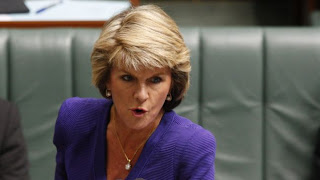 "Loving the hairstyle of the Deputy Leader of the Opposition in Australia. I hear she was Krystal Carrington's stunt double in Dynasty"
I didn't realise I had so many twitter followers here in Australia, as this appeared in most of the newspaper diary columns the next day. As you're about to see, I didn't learn my lesson...
My first speaking commitment was at the Sydney Institute on Monday evening, where I gave a talk on the world of political blogging and new media. It was a very engaged audience, who seemed well versed in British politics. Sajid Javid MP had been there the week before. Later that evening AMP hosted a dinner for me at the top of their harbourside office block. The night views over the Opera House and Harbour Bridge were stupendous. But it really was singing for my supper. There were about 20 guests and they grilled me between courses for a good couple of hours. Still, liking the sound of my own voice has never been a problem for me!
On Tuesday it was up early for the flight to Canberra. Very early. We got to the Hyatt in Canberra at about 10am. I had two speeches to complete writing, but I was so tired I thought I'd have a quick zzzz before getting down to it. Quick zzzz. Hmmm. I woke up at 2pm. Bugger. But luckily just in time to watch Question Time again. In Australia, the House of Commons sits for only 80 days a year - an innovation we should copy - and on each day there is a 90 minute Question Time session in which all government ministers partake. The behaviour in the chamber on this occasion was even worse than the day before. And that's saying something. I like adversarial politics. I would hate to have a sterile chamber like the US House of Representatives or the German Bundestag, but the Australians take adversarial politics to ridiculous levels. The pure hatred and loathing on the facts of the Prime Minister and Leader of the Opposition have to be seen to be believed. And the others take their lead from them. The Speaker, a gentle soul called Harry Jenkins, seems powerless to call order. Every few seconds he murmurs 'Order' but few take any notice. He names people. Still they take no notice. He can send people out of the chamber for an hour to cool down, and does. He can ban people. But they see no shame in being named or sin-binned. Indeed, it seems to be a badge of honour. The Speaker doesn't ever seem to stand. He just sits there and every 20 seconds or so, says 'Order'. To me, he is part of the problem. He's not an authority figure, and boy does that chamber need an authority figure. Anyway, during Tuesday's session I tweeted this...
"The UK House of Commons is often accused of behaving like a playground. It has nothing on the Aussie House of Reps. Unbelievable behaviour."
 This led to quite a strong reaction on Twitter and gained me about 200 extra followers. Remarkably virtually everyone agreed. In retrospect I suppose I might have got a lot of tweets accusing me of being a whinging Pom, but there was only one blogger who really took issue with me and that was because of a bit of a misunderstanding. As a result of the tweet the BBC World Service rang and asked if I would expand on my view on their World Update programme with Dan Damon, which I duly did. Unfortunately they then posted a heavily edited transcript of my remarks, which they made out was an article by me. It wasn't.
And so it started. Radio interview after radio interview about what I had said. This afternoon I did a half hour phone in on Sydney's ABC 702AM station, which is their equivalent of ABC. Remarkably every caller agreed with me. Tomorrow I am on with Andrew Bolt on the Melbourne Breakfast show and then a station in Perth. It's remarkable what one tweet can launch!
If you think I am exaggerating about the Australian Parliament read THIS superb article by the FT's Matthew Engel.
That evening I met a dozen Aussie bloggers for dinner, along with several people from Microsoft.
 Next morning, it was showtime! I delivered the keynote speech at the Microsoft/Open Forum Politics & Technology Forum at Parliament House. My speech was to be on Openness & Transparency and was scheduled to last 40 minutes. I have to say I don't think I have ever given a 40 minute speech before. I reckon that unless you're Martin Luther King or Barack Obama, people tend to switch off after 20 minutes no matter how good you are. So I deliberately timed a vicious attack on Julian Assange for the 25 minute mark. It worked. I think.
I then took part in a 90 minute long panel with top Aussie blogger Stilgherrian (that's his real name. He doesn't have a second one), Gianpaolo Carrera from Microsoft, Professor Eric Clements from the US, Shadow Chancellor (or Treasurer as they say here) Joe Hockey and Sentator Kate Lundy, PPS to the Prime Minister and Sarah Palin look-a-like (and I mean that in an admiring way, Kate!) and an expert in social media. It all seemed to go off well. I wasn't sure if my speech had worked, but all the twitter reaction seemed positive.
Later on, over lunch, I delivered a second speech to the All Party UK/Australia Friendship group of Senators and MPs. It was good to meet so many of them, especially the redoubtable Bronwyn Bishop, who I hit it off with - she's Australia's answer to Ann Widdecombe! I talked about the role of technology in the 2010 election.
Later in the afternoon we flew back to Sydney. I was due to have dinner with my old colleague from 18 Doughty Street days, Alice Wright, but I was so tired I put her off until Monday.
Today I had breakfast and lunch with Shane Stone. Shane is on the board of the holding company which owns Biteback, and he is the former Chief Minister of the Northern Territories and also a former Liberal Party President. Next week I am going to Darwin to stay with him. We're apparently going fishing in crocodile country, 300km west of Darwin. Apparently the boats have to have reinforced floors to stop the crocs biting through. I shall try not be a wuss.
I also went to the Microsoft offices to talk to 30 or 40 of their staff. I did it all off the cuff today, which is my favoured method of speaking and we had a really good Q & A. And that was the final part of the working bit of my trip.
I now have 6 days in Sydney to do as I please. I reckon I shall take a few day trips out of the city, maybe to the Blue Mountains one day and the Hunter Valley another. I also want to do a Sydney Harbour boat trip.
And I also need to start thinking about inviting guests to appear on my LBC show. The question is: will I be able to persuade people to come to the studios for 6am!
Just a final word about my first impressions of Australia on this visit. The one thing that has struck me so far is that it is an incredible optimistic, cheerful nation. People actually smile at you. You don't get many smiles to the dozen in London, but here, it's as if people are enjoying life and are not letting problems get them down. Sydney is a very cosmopolitan city and on the outside at least has coped very well with integrating a huge number of migrants from fellow Asian countries. But the prices! My God, this is the most expensive place I have ever been in my life. It's far more expensive than Scandinavia and Switzerland. A Mars Bar costs £2! A can of coke in the hotel is £5. I ordered a club sandwich, a cranberry juice and a cherry strudel desert. The bill came to more than £55. Breakfast is £30. Madness. Luckily, it;s those nice people at Microsoft who are paying, but after Saturday I am on my own!
Anyway, I have rambled on for long enough. I'll write another blogpost next weekend, assuming I haven't been eaten by crocodiles in the Northern Territories by then...
There are very few countries in the world I could live in. Australia is one of them. When I came here twenty years ago, I had expected not to like Australia. I have no idea why I thought that, because I fell in love with the country. Unfortunately, on that trip I only had about 2 days free time so had little opportunity to have a proper look round. We went to Sydney, Melbourne and Canberra, but spent all our time working. We were advising the Australian Liberal Party on reforming laws governing the employment of dock workers. On our first day in the country we were warned that if the dockers' unions found out we were here, our lives would be in danger. Nice. There was no such warning this time!
I never intended to wait twenty years to return, but time somehow just slipped by. So, why am I here? Well, those nice people at Microsoft invited me to do a week long speaking tour, and frankly, who was I to refuse? I then thought that it was rather idiotic just to spend one week here, so tagged on another week, and then had the bright idea of broadcasting my LBC show for a week from Sydney, and I will be doing that from 13-18 June. Unfortunately I miscalculated the time difference and I will actually be broadcasting my normal evening show from 4am to 7am in the morning.
I arrived in the country on Sunday morning and had a day and a half before my first speaking engagement. On Monday morning I recorded a 30 minute podcast interview with one of Australia's leading bloggers, Stilgherrian, which you can find HERE.
On Monday afternoon I switched on the Australian version of Sky News (same graphics and music as the UK version, interestingly) to watch Question Time from the House of Representatives in Canberra. More of that later. Ahem. One thing though, I was rather captivated by the Australian Deputy Leader of the Opposition, Julie Bishop, who I had never encountered before. I tweeted...
 "Loving the hairstyle of the Deputy Leader of the Opposition in Australia. I hear she was Krystal Carrington's stunt double in Dynasty"
I didn't realise I had so many twitter followers here in Australia, as this appeared in most of the newspaper diary columns the next day. As you're about to see, I didn't learn my lesson...
My first speaking commitment was at the Sydney Institute on Monday evening, where I gave a talk on the world of political blogging and new media. It was a very engaged audience, who seemed well versed in British politics. Sajid Javid MP had been there the week before. Later that evening AMP hosted a dinner for me at the top of their harbourside office block. The night views over the Opera House and Harbour Bridge were stupendous. But it really was singing for my supper. There were about 20 guests and they grilled me between courses for a good couple of hours. Still, liking the sound of my own voice has never been a problem for me!
On Tuesday it was up early for the flight to Canberra. Very early. We got to the Hyatt in Canberra at about 10am. I had two speeches to complete writing, but I was so tired I thought I'd have a quick zzzz before getting down to it. Quick zzzz. Hmmm. I woke up at 2pm. Bugger. But luckily just in time to watch Question Time again. In Australia, the House of Commons sits for only 80 days a year - an innovation we should copy - and on each day there is a 90 minute Question Time session in which all government ministers partake. The behaviour in the chamber on this occasion was even worse than the day before. And that's saying something. I like adversarial politics. I would hate to have a sterile chamber like the US House of Representatives or the German Bundestag, but the Australians take adversarial politics to ridiculous levels. The pure hatred and loathing on the facts of the Prime Minister and Leader of the Opposition have to be seen to be believed. And the others take their lead from them. The Speaker, a gentle soul called Harry Jenkins, seems powerless to call order. Every few seconds he murmurs 'Order' but few take any notice. He names people. Still they take no notice. He can send people out of the chamber for an hour to cool down, and does. He can ban people. But they see no shame in being named or sin-binned. Indeed, it seems to be a badge of honour. The Speaker doesn't ever seem to stand. He just sits there and every 20 seconds or so, says 'Order'. To me, he is part of the problem. He's not an authority figure, and boy does that chamber need an authority figure. Anyway, during Tuesday's session I tweeted this...
"The UK House of Commons is often accused of behaving like a playground. It has nothing on the Aussie House of Reps. Unbelievable behaviour."
 This led to quite a strong reaction on Twitter and gained me about 200 extra followers. Remarkably virtually everyone agreed. In retrospect I suppose I might have got a lot of tweets accusing me of being a whinging Pom, but there was only one blogger who really took issue with me and that was because of a bit of a misunderstanding. As a result of the tweet the BBC World Service rang and asked if I would expand on my view on their World Update programme with Dan Damon, which I duly did. Unfortunately they then posted a heavily edited transcript of my remarks, which they made out was an article by me. It wasn't.
And so it started. Radio interview after radio interview about what I had said. This afternoon I did a half hour phone in on Sydney's ABC 702AM station, which is their equivalent of ABC. Remarkably every caller agreed with me. Tomorrow I am on with Andrew Bolt on the Melbourne Breakfast show and then a station in Perth. It's remarkable what one tweet can launch!
If you think I am exaggerating about the Australian Parliament read THIS superb article by the FT's Matthew Engel.
That evening I met a dozen Aussie bloggers for dinner, along with several people from Microsoft.
 Next morning, it was showtime! I delivered the keynote speech at the Microsoft/Open Forum Politics & Technology Forum at Parliament House. My speech was to be on Openness & Transparency and was scheduled to last 40 minutes. I have to say I don't think I have ever given a 40 minute speech before. I reckon that unless you're Martin Luther King or Barack Obama, people tend to switch off after 20 minutes no matter how good you are. So I deliberately timed a vicious attack on Julian Assange for the 25 minute mark. It worked. I think.
I then took part in a 90 minute long panel with top Aussie blogger Stilgherrian (that's his real name. He doesn't have a second one), Gianpaolo Carrera from Microsoft, Professor Eric Clements from the US, Shadow Chancellor (or Treasurer as they say here) Joe Hockey and Sentator Kate Lundy, PPS to the Prime Minister and Sarah Palin look-a-like (and I mean that in an admiring way, Kate!) and an expert in social media. It all seemed to go off well. I wasn't sure if my speech had worked, but all the twitter reaction seemed positive.
Later on, over lunch, I delivered a second speech to the All Party UK/Australia Friendship group of Senators and MPs. It was good to meet so many of them, especially the redoubtable Bronwyn Bishop, who I hit it off with - she's Australia's answer to Ann Widdecombe! I talked about the role of technology in the 2010 election.
Later in the afternoon we flew back to Sydney. I was due to have dinner with my old colleague from 18 Doughty Street days, Alice Wright, but I was so tired I put her off until Monday.
Today I had breakfast and lunch with Shane Stone. Shane is on the board of the holding company which owns Biteback, and he is the former Chief Minister of the Northern Territories and also a former Liberal Party President. Next week I am going to Darwin to stay with him. We're apparently going fishing in crocodile country, 300km west of Darwin. Apparently the boats have to have reinforced floors to stop the crocs biting through. I shall try not be a wuss.
I also went to the Microsoft offices to talk to 30 or 40 of their staff. I did it all off the cuff today, which is my favoured method of speaking and we had a really good Q & A. And that was the final part of the working bit of my trip.
I now have 6 days in Sydney to do as I please. I reckon I shall take a few day trips out of the city, maybe to the Blue Mountains one day and the Hunter Valley another. I also want to do a Sydney Harbour boat trip.
And I also need to start thinking about inviting guests to appear on my LBC show. The question is: will I be able to persuade people to come to the studios for 6am!
Just a final word about my first impressions of Australia on this visit. The one thing that has struck me so far is that it is an incredible optimistic, cheerful nation. People actually smile at you. You don't get many smiles to the dozen in London, but here, it's as if people are enjoying life and are not letting problems get them down. Sydney is a very cosmopolitan city and on the outside at least has coped very well with integrating a huge number of migrants from fellow Asian countries. But the prices! My God, this is the most expensive place I have ever been in my life. It's far more expensive than Scandinavia and Switzerland. A Mars Bar costs £2! A can of coke in the hotel is £5. I ordered a club sandwich, a cranberry juice and a cherry strudel desert. The bill came to more than £55. Breakfast is £30. Madness. Luckily, it;s those nice people at Microsoft who are paying, but after Saturday I am on my own!
Anyway, I have rambled on for long enough. I'll write another blogpost next weekend, assuming I haven't been eaten by crocodiles in the Northern Territories by then...
Subscribe to:
Posts (Atom)